Giant and Big Scissors: Types, Sizes and What Each Is For
- Author: Ceremonial Scissors Guide Editorial Team
- Published on
- Category: Scissors
Giant scissors and big scissors are not one product. The phrase covers ceremonial pairs for ribbon cuttings, props and displays, oversized craft pieces and heavy-duty cutting shears. Each has a different purpose, build and safety profile, so decide what you need the pair to do first, then read the listing for blade type and construction.
Part of our guide: Ribbon Cutting Scissors: Types, Sizes and How to Choose
Giant scissors and big scissors are broad search terms, and the right answer depends on what you need. This page sorts the options so you can pick the right kind, then sends you to our ribbon cutting scissors guide if the purpose is a ceremony.
What do people mean by giant or big scissors?
The word scissors only says a cutting instrument with two blades. Giant, big, large, huge and oversized are size words, and they say nothing about purpose. That is why one search can surface a ribbon cutting pair, a theater prop, a craft project and an industrial tool. The table above summarizes the four meanings that matter.
Ceremonial ribbon cutting scissors
These are chosen for an opening, dedication or similar event. They are made to be seen, so they are usually decorative and often large. Some have working blades and some do not. See ceremonial scissors explained and how big giant scissors are.
Prop and display scissors
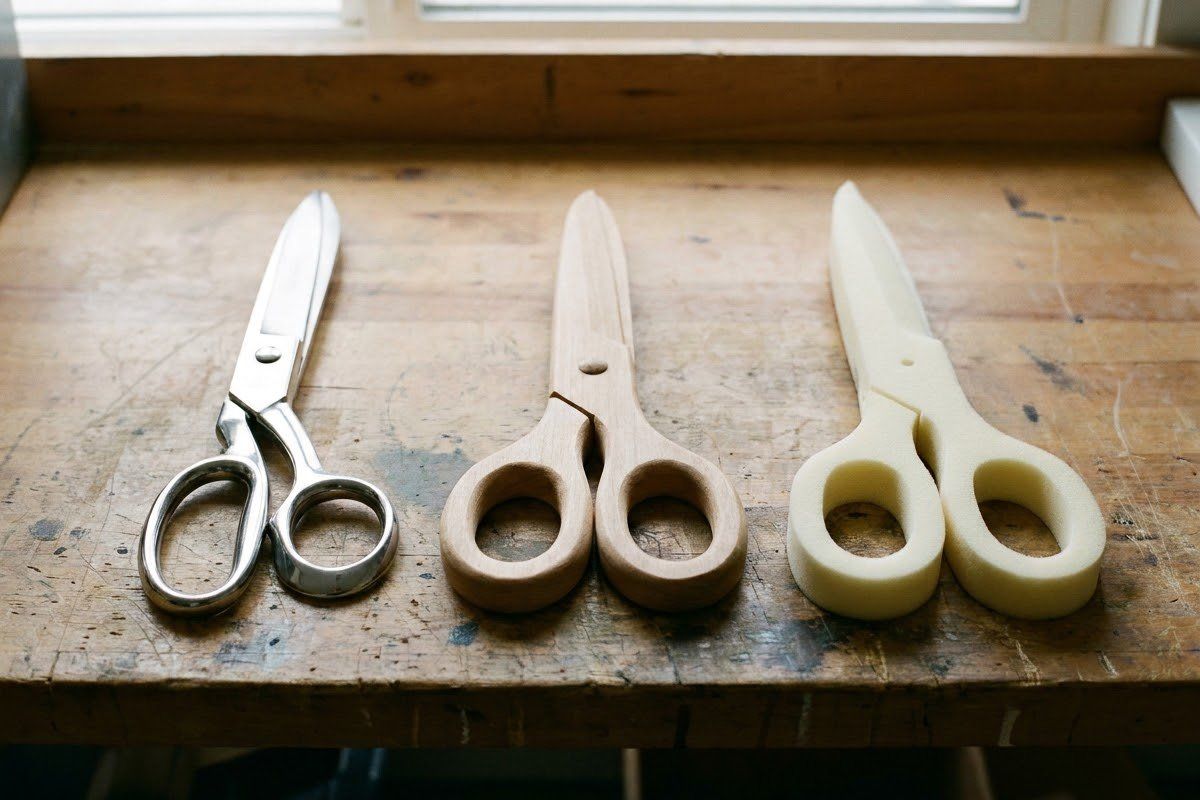
A prop is, in theater and film, any item on the set other than costumes and scenery. Prop scissors are built to look like scissors, not to cut. They are made of foam, wood or plastic and are light. Our page on giant prop scissors shows how to tell one from a real pair.
Craft and DIY oversized scissors
Cardboard or foam giant scissors are a common craft or classroom item. They are off topic for this site, which focuses on ceremonial pairs. If you are building a prop for an event, keep edges and points blunt and avoid anything that could fall on someone.
Heavy-duty cutting shears
Industrial shears for cutting sheet, fabric or material are workshop tools, not ceremonial objects. OSHA says hand tools can cause severe injuries when used or maintained improperly, and workshop shears fall squarely under that warning. We do not cover them.
How do you tell them apart before you pick one?
Ask four questions of any listing: does it say the blades cut, what is it made of, what is the stated length and weight, and who is it designed for? A listing that names a material (metal, wood, foam) and states whether it cuts answers most of the questions. If it does not, ask the seller or lender, or move on. For materials, read what ceremonial scissors are made of. For sources, where to find ribbon cutting scissors describes the types of sources.
If a product turns out to be unsafe, CPSC lets consumers report it through saferproducts.gov, linked from the CPSC home page.
A quick way to decide what you need
Start with the purpose, not the size. If someone will hold the pair at an opening, you want ceremonial scissors and the safety guide. If it is for display or a photograph only, a prop is simpler and lighter. If you need something to cut real material, you want a workshop tool, which this site does not cover. Write that purpose in one line before you contact any source, and give the same line to every source you ask.
General information only. Follow the maker’s instructions and your venue’s rules.
| Feature | Ceremonial pair | Prop or display | Craft or DIY piece | Heavy-duty shears |
|---|---|---|---|---|
| Main purpose | Symbolic ribbon cut | Looks right in photos or on a set | Decoration, costume, classroom | Real cutting work |
| Blades cut? | Sometimes | Usually not | Usually not | Yes |
| Typical build | Metal, sometimes plated or lacquered | Foam, wood or plastic | Cardboard, foam, wood | Steel, work grade |
| Covered on this site | Yes | Yes, briefly | No | No, off topic |
For a ribbon cutting, you want a ceremonial pair. For decoration or photos, a prop is fine. Heavy-duty shears are a workshop tool and are not covered here.
People also ask
What are big scissors called?
Big scissors have no single name. Depending on use, people say giant scissors, oversized scissors, ceremonial scissors, prop scissors or shears. In a ribbon cutting context the usual term is ceremonial or ribbon cutting scissors, with giant, large or big describing the size. A dictionary lists scissors as a two-bladed cutting instrument, so qualifiers carry the meaning.
Are giant scissors real or just props?
Both exist. Some giant scissors are real tools with working blades, some are ceremonial pieces with limited cutting ability, and many are props made of foam, wood or plastic. Read the listing for blade material and a statement about cutting. If it says decorative, display or prop, assume the blades will not cut ribbon.
What are giant scissors used for?
Common uses include ribbon cuttings at openings and dedications, photo displays, theater and film props, classroom or craft projects, and workshop cutting of heavy material with industrial shears. Pick the type for the job. A ceremonial pair is made to be seen, while a workshop pair is made to cut, and they are rarely the same object.
Can giant scissors cut ribbon?
It depends on the pair. A ceremonial pair with working blades can cut ribbon, though large handles make a clean cut harder. A prop pair generally cannot. Check the description, test with a short piece of the same ribbon before the event, and keep ordinary scissors ready as a backup.
Are giant scissors safe for children?
Treat giant scissors as an adult item unless the maker clearly states otherwise. Blades and points can injure, and the pair is heavy. Keep children away from the edges and never let them hold a real pair unsupervised. OSHA's general warning about hand tools applies to oversized ones too.
Further reading
- Dictionary.com: scissors (dictionary.com)
- Dictionary.com: prop (dictionary.com)
- OSHA: Hand and Power Tools (osha.gov)
- U.S. Consumer Product Safety Commission (cpsc.gov)
Worth reading next
- Ribbon Cutting Scissors: Types, Sizes and How to Choose
What ribbon cutting scissors are, how standard, large and giant sizes differ, which blades really cut, and how to choose a pair for your opening.
- Ceremonial Scissors Explained: What They Are and How They Work
What makes scissors ceremonial, whether the blades really cut, what parts they have and how they differ from ordinary scissors, in plain language.
- What Ceremonial Scissors Are Made Of: Metal, Plated, Wood and Plastic
Metal, plated, wood and plastic ceremonial scissors compared, what gold plated and gold finish mean, and which material fits which event.
- Giant Ribbon Cutting Scissors: How Big Is Big?
How big giant ribbon cutting scissors are, why big, large and huge mean the same thing, and how to match size to viewing distance, weight and handling.
- Giant Prop Scissors: Props Versus Real Ceremonial Scissors
What giant prop scissors are, how foam, cardboard, plastic and wood props differ from real ceremonial scissors, and when a prop is fine for an event.
- Grand Opening Scissors: Choosing for a Business Opening
How to choose grand opening scissors for a shop, office or restaurant: size for the crowd, indoor or outdoor use, ribbon pairing and an items checklist.