Ribbon Cutting Scissors: Types, Sizes and How to Choose
- Author: Ceremonial Scissors Guide Editorial Team
- Published on
Ribbon cutting scissors are the oversized, decorative pairs used to cut the ribbon at an opening. They come in standard, large and giant sizes, and some have blades that really cut while others are display pieces. Choose by how far your audience stands, whether you need a working cut, and who will handle the pair, then follow the maker's instructions.
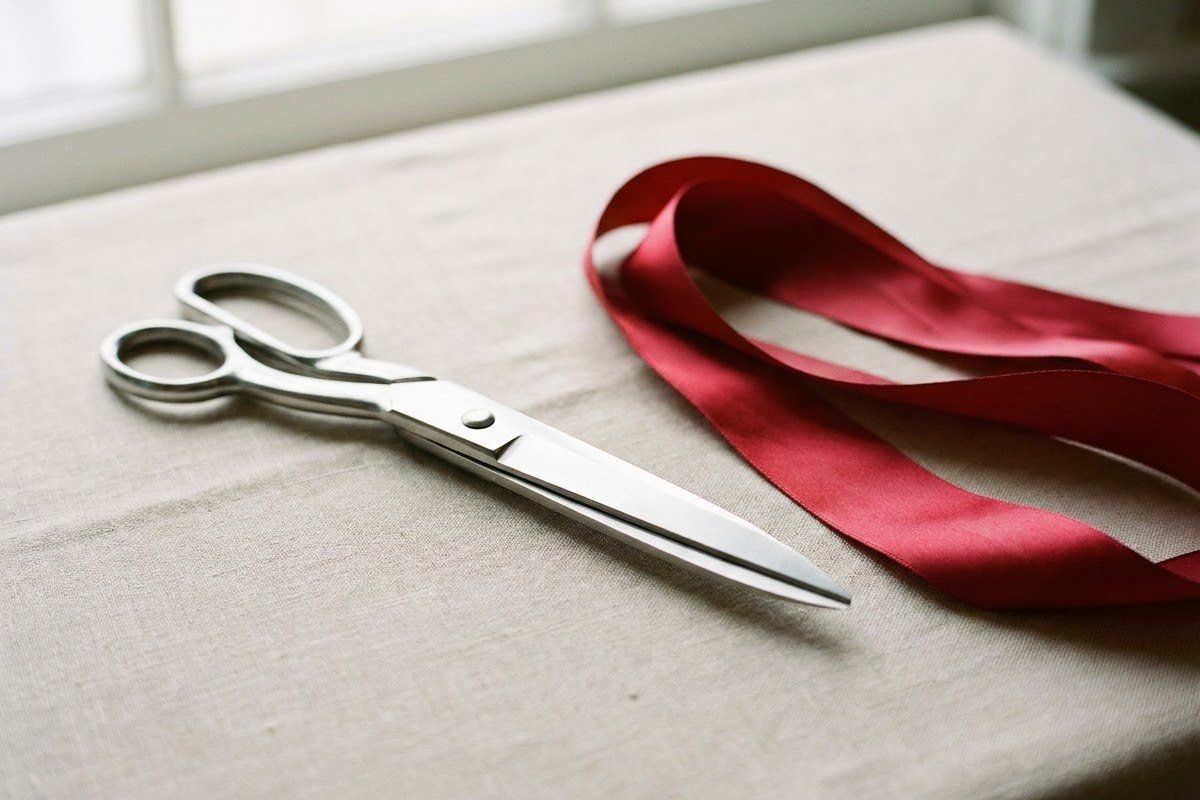
Ribbon cutting scissors are oversized scissors made for the moment a ribbon is cut at an opening. This guide is the hub for everything about the object itself: the types, the sizes, what the blades do, what they are made of and how to choose. Event order, speeches and invitations are for the organizer to plan and are not covered here.
What are ribbon cutting scissors?
Ribbon cutting scissors are scissors made larger and more decorative than everyday ones so that a small action can be seen by a crowd. The word scissors itself means a cutting instrument of two blades, and ceremonial means used in or in connection with ceremonies. Put together, the term describes a pair chosen for the occasion rather than for daily work.
Because “ceremonial” describes a purpose, not a build quality, two pairs with the same name can be very different objects. One may have sharpened steel blades. Another may be a decorated display piece. Ceremonial scissors explained goes through what makes a pair ceremonial in more detail.
Standard, large and giant: what do the sizes mean?
We found no official size scale, so the labels come from sellers and makers and are not comparable between them. In practice the labels describe three bands: a pair you can hold in one hand, a pair clearly larger than that, and a pair that is meant to be seen from a distance and often needs two people.
The table above summarizes the pattern. The deciding question is visibility. If your audience stands close, a standard pair reads fine. If they stand far back or you want a strong photo, look at the larger classes. Our page on how big giant scissors are explains the geometry, and the sizing tool turns it into a suggestion for your distance and crowd.
Do the blades really cut?
Blade type is the most important thing to find out before you commit. There are three common situations:
- Working blades. The pair is meant to cut ribbon. Even so, large handles and long blades make the cut less crisp than with small scissors.
- Display blades. The edges are blunt or the blades do not meet cleanly. Such a pair needs a ribbon that is pre-cut or held by a thin joint.
- Prop construction. Foam, wood or plastic that only looks like scissors. See giant prop scissors for how to tell a prop from a real pair. For a wider sort of everything people call big scissors, see giant and big scissors.
Listings describe this in different words, so look for a plain statement about whether the blades cut and what ribbon they were designed for. If it is not stated, ask the maker or lender before you rely on it. How to cut ribbon cleanly covers ribbon tension and a backup plan.
What are ceremonial scissors made of?
Metal is the most common construction for a working or display pair, but finishes vary: polished, plated, painted or lacquered. Some large decorative pairs are wood or plastic. A finish described as gold or silver may only be a surface layer, and the wording rules for that come from consumer-protection guidance rather than from the scissors trade. Read what ceremonial scissors are made of before you decide that a finish is solid or plated.
Handles, grips and two-person designs
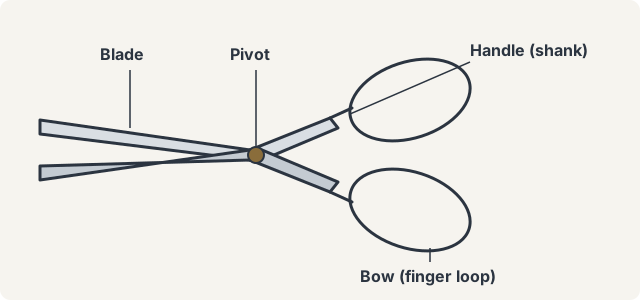
Handle shape changes how safely a pair is held. Small finger loops suit one hand. Large open bows suit two hands or two people, one on each handle. If two people will cut together, check that both handles are strong enough for a firm squeeze and that the pivot is firm, so the blades do not wobble when the pair is lifted.
What comes with a set?
A set usually means the scissors plus a ribbon, and sometimes a bow, a case, a stand or a presentation box. What is included differs by maker, and a set is not a promise that the blades cut the ribbon in the box. See ribbon and scissors sets for a checklist of items to confirm.
How do you choose by event size?
Work backwards from the audience:
- Estimate the farthest spot where someone will stand to watch or photograph the cut.
- Choose the smallest size class that still looks clearly oversized from there.
- Decide whether you need a real cut, and choose or test the ribbon accordingly.
- Decide who will hold the pair, and how it will be carried to and from the site.
- Check the case, stand and storage space.
For an opening of a shop or office, grand opening scissors goes through indoor, outdoor and storefront situations, and the ribbon for a ribbon cutting guide helps match the ribbon to the pair.
Rent, buy or borrow?
Renting or borrowing suits a single event. Buying suits an organization that cuts ribbons often or wants a keepsake. The page on renting versus buying sets out the questions to ask in each case, and where to find ribbon cutting scissors describes the kinds of sources without recommending any seller.
Care and safety
OSHA states that hand tools can be hazardous and cause severe injuries when used or maintained improperly. A large pair of scissors is a hand tool, even if it is used once a year. Keep the blades closed or covered when the pair is carried, store it where children cannot reach it, and do not let anyone test the edge with a finger. The ribbon cutting scissors safety page gives a longer list, and caring for ceremonial scissors covers cleaning and storage.
If a pair is sold as a children’s item, the Consumer Product Safety Commission has a sharp point test for articles intended for children under 8 (16 CFR 1500.48). That rule concerns the manufacturer of children’s articles. It does not make an adult pair safe for a child, and it is no substitute for supervision.
General information only. Follow the maker’s instructions and your venue’s rules.
| Feature | Standard | Large | Giant |
|---|---|---|---|
| How makers describe it | Oversized compared with desk scissors, still carried in one hand | Clearly oversized, often held with two hands | Very large, often shown on a stand or handled by two people |
| Best for | Small rooms, shop doorways, a few onlookers | Storefronts, halls, a modest crowd | Large crowds, outdoor sites, long photo distances |
| Does the blade usually cut? | Often, check the listing | Varies by maker | Varies; many are display pieces |
| Handling | One person | One or two people | Two people and a plan for carrying and storing |
| Storage and transport | Case or box that fits a car | Case or box, check door and trunk size | Needs dedicated space and a safe way to move it |
Pick the smallest class that is still readable from the farthest place people will stand, confirm whether the blades cut the ribbon you chose, and plan who will carry and store the pair.
All Scissors guides
- Ceremonial Scissors Explained: What They Are and How They Work
What makes scissors ceremonial, whether the blades really cut, what parts they have and how they differ from ordinary scissors, in plain language.
- Giant and Big Scissors: Types, Sizes and What Each Is For
Giant and big scissors can mean ceremonial pairs, props, craft pieces or heavy shears. Learn the types, how to tell them apart and what each is for.
- Giant Prop Scissors: Props Versus Real Ceremonial Scissors
What giant prop scissors are, how foam, cardboard, plastic and wood props differ from real ceremonial scissors, and when a prop is fine for an event.
- Giant Ribbon Cutting Scissors: How Big Is Big?
How big giant ribbon cutting scissors are, why big, large and huge mean the same thing, and how to match size to viewing distance, weight and handling.
- Grand Opening Scissors: Choosing for a Business Opening
How to choose grand opening scissors for a shop, office or restaurant: size for the crowd, indoor or outdoor use, ribbon pairing and an items checklist.
- What Ceremonial Scissors Are Made Of: Metal, Plated, Wood and Plastic
Metal, plated, wood and plastic ceremonial scissors compared, what gold plated and gold finish mean, and which material fits which event.
People also ask
What are ribbon cutting scissors?
Ribbon cutting scissors are oversized scissors used to cut the ribbon at an opening or dedication. They are chosen for looks and visibility as much as for cutting. Some pairs have working blades, others are display pieces that need a pre-cut ribbon. Makers describe sizes in different ways, so always read the listing for the actual blade type and dimensions.
Do ceremonial scissors actually cut?
Some do and some do not. A working pair has blades meant to cut ribbon, while a display or prop pair is built to look right in photos. There is no single rule, so check the maker's description, test a short length of the same ribbon before the event, and keep a spare pair of ordinary scissors nearby for the cut if the large pair struggles.
What size are ribbon cutting scissors?
There is no official size. Makers use their own labels such as standard, large and giant, and the numbers behind those labels differ from one maker to the next. Use the scissor size guide on this site to match a size class to the distance your audience stands, then compare dimensions in each listing in inches or centimetres.
How do I choose scissors for a ribbon cutting?
Start with the farthest viewing distance, then pick a size class that stays readable there. Next decide whether the blades must really cut, how many people will hold the pair, and where it will be stored. Finish by checking handling instructions and any rules your venue has about sharp objects. Renting or borrowing can suit a one-off event.
What is the difference between ceremonial and regular scissors?
Ceremonial scissors are built for display and a symbolic cut, so they are larger, more decorative and often heavier. Regular scissors are built for repeated cutting, with comfortable handles and sharp, well aligned blades. A ceremonial pair can look impressive but cut poorly, which is why many events keep an ordinary pair ready.
Are giant scissors safe to use?
Giant scissors can be used safely when the blades are controlled, the pair is carried by the right number of people, and children are kept away from the edges. OSHA notes that hand tools can cause severe injuries when used or maintained improperly. Read the handling notes on our safety page and follow the maker's instructions and your venue's rules.
Further reading
- Dictionary.com: scissors (dictionary.com)
- Dictionary.com: ceremonial (dictionary.com)
- OSHA: Hand and Power Tools (osha.gov)
- eCFR: 16 CFR 1500.48, sharp point test for articles for children under 8 (ecfr.gov)
Worth reading next
- Ceremonial Scissors Explained: What They Are and How They Work
What makes scissors ceremonial, whether the blades really cut, what parts they have and how they differ from ordinary scissors, in plain language.
- What Ceremonial Scissors Are Made Of: Metal, Plated, Wood and Plastic
Metal, plated, wood and plastic ceremonial scissors compared, what gold plated and gold finish mean, and which material fits which event.
- Giant Ribbon Cutting Scissors: How Big Is Big?
How big giant ribbon cutting scissors are, why big, large and huge mean the same thing, and how to match size to viewing distance, weight and handling.
- Giant and Big Scissors: Types, Sizes and What Each Is For
Giant and big scissors can mean ceremonial pairs, props, craft pieces or heavy shears. Learn the types, how to tell them apart and what each is for.
- Giant Prop Scissors: Props Versus Real Ceremonial Scissors
What giant prop scissors are, how foam, cardboard, plastic and wood props differ from real ceremonial scissors, and when a prop is fine for an event.
- Grand Opening Scissors: Choosing for a Business Opening
How to choose grand opening scissors for a shop, office or restaurant: size for the crowd, indoor or outdoor use, ribbon pairing and an items checklist.